
Changa Manga is open through the year, but the forest you meet in February is not the forest you meet in June. Here is what each Punjab season does to the plantation — and who each season is for.
Status note (26 Oct 2026): “open through the year” is the rule in normal times — but the forest park has been widely reported as temporarily closed through 2026 for a major redevelopment, with no official reopening date yet. Check the current status before planning around any season below.
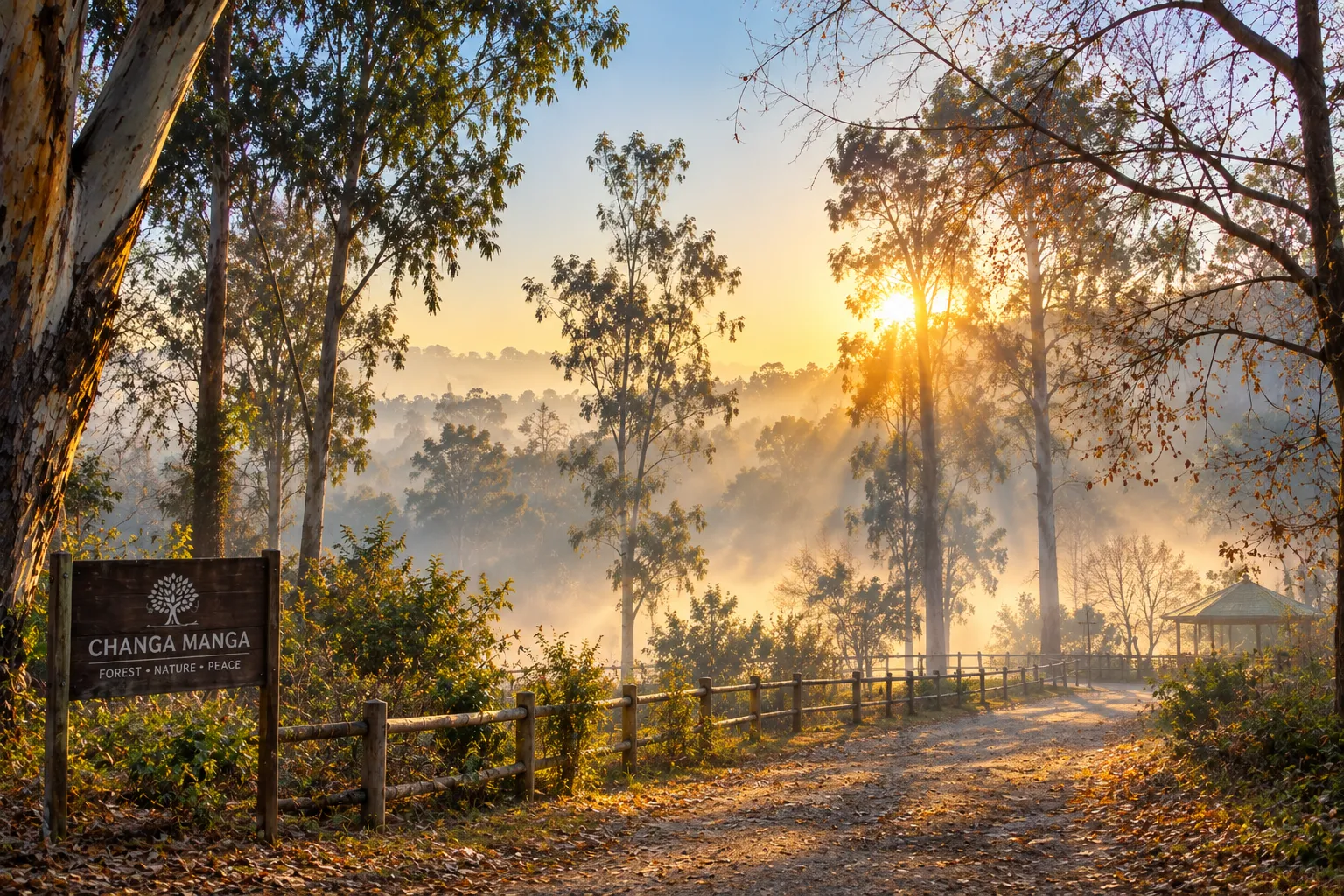
Changa Manga Weather: What the Forecast Is Actually For
Weather apps list the spot by name — search “Chhanga Manga” on AccuWeather or any forecast service and you get readings for the forest’s own locality, not a district-city average. That is the forecast worth checking, because the plantation sits in open farmland on the Lahore plains, where three kinds of weather rewrite a visit.
Heat (April to June): daytime highs regularly cross 40°C and the open lawns radiate it back; the deep shade keeps walking possible, but mornings only. Monsoon (July to September): rain arrives in dramatic bursts rather than all-day drizzle, so the question is not “will it rain?” but “when will it burst?” — a morning slot dodges most of it, and the forest is at its greenest. Fog (December to January): the drive, not the forest, is the problem — the N-5 can sit under mist till mid-morning. The rest of the year, including late October as we write this, runs dry and warm: days near 30°C, evenings pleasant, forests golden.
The pattern to remember: Changa Manga rarely has bad-weather days, it has wrong-hour days — and each one is fixable by choosing your hours with the seasons below.
Changa Manga Weather Month by Month
For readers who want the whole year on one screen, here is the long-term shape of the Punjab plains season at the nearest major weather station — the numbers behind the season guide above.
| Month | Average high | Average low | Average rain |
|---|---|---|---|
| January | 19°C | 7°C | 21 mm |
| February | 22°C | 11°C | 30 mm |
| March | 28°C | 17°C | 57 mm |
| April | 33°C* | 20°C | 45 mm |
| May | 39°C | 26°C | 42 mm |
| June | 40°C | 28°C | 79 mm |
| July | 36°C | 27°C | 224 mm |
| August | 35°C | 26°C | 154 mm |
| September | 34°C | 25°C | 114 mm |
| October | 32°C | 21°C | 10 mm |
| November | 27°C | 15°C | 14 mm |
| December | 21°C | 9°C | 10 mm |
How to read it: these are long-term averages, not promises — an “average high of 39°C” in May still means afternoons that cross 40°C, and July’s 224 mm arrives in a handful of dramatic bursts, not a steady drizzle. For your actual date, search the forecast for the locality’s own name, “Chhanga Manga”, rather than Lahore’s.
Source & caveats: Lahore station (WMO 41640) long-term monthly averages, 1981–2020, from Pakistan Meteorological Department records in NOAA’s international archive (NCEI Global Summary of the Month), computed 8 Nov 2026. The archive’s coverage varies by month, and April’s average high rests on only three reporting years (*), so read that figure as the pattern, not a precise normal. Changa Manga sits 74 km from the station — a degree or two of difference is normal.
Winter: October to March (The Golden Window)
Weather: mild days, cool evenings, low humidity.
This is when Changa Manga is at its most generous. Walking is comfortable all day, birds are active from dawn, and the low winter sun throws long golden lines down the plantation avenues — a photographer’s dream. Weekend crowds are liveliest in December and January; a weekday morning in November or February is arguably the perfect visit.
December and January add one winter wrinkle: fog. The Lahore plains wake under it regularly in deep winter, and the early N-5 stretch of the drive can be slow and white. The fix is simple — check the forecast the night before, keep full lights on, and if the morning is a white one, start later; the forest stays cool and golden till late afternoon in winter, so you lose almost nothing.
- Best for: first-time visitors, families with small children, photography, birdwatching
- Watch out: cold mornings — pack jackets for the drive home; fog on December–January highways
Summer: April to June (The Early-Bird Season)
Weather: hot, dry, intense midday sun.
By mid-day, the open lawns are unforgiving. But the forest’s deep shade still works its magic if you time it right: arrive at opening, walk the shady corridors, leave by early afternoon. The canopy in summer is dense and dark — the “green tunnel” photos you have seen are usually summer shots.
- Best for: early risers, shade-loving photographers, empty paths
- Watch out: heat exhaustion is real; carry far more water than you think you need
Monsoon: July to September (The Green Season)
Weather: humid, dramatic skies, heavy rain bursts.
The forest drinks well in monsoon and looks its greenest — everything deepens, from canopy to undergrowth. Paths can be muddy, mosquitoes come alive at dusk, and some activities may pause during heavy weather. But the monsoon forest has a wild, cinematic atmosphere that dry months cannot imitate.
- Best for: atmosphere seekers, green-scenery photographers, repeat visitors
- Watch out: mud, insects, and the possibility that rides or facilities pause without notice
Five Timing Rules That Always Apply
- First two hours after opening are the best two hours, in every season.
- Weekdays beat weekends — dramatically, especially December to February.
- Avoid midday in summer entirely; plan a long picnic lunch in shade instead.
- Public holidays bring half of Lahore along — come for the crowd-fest if that is your thing, otherwise steer clear.
- Confirm activities on your date — the train, boats and pool do not run to a published guarantee, whatever the season. The timings and entry checklist covers what to confirm before you go.
The One-Line Answer
If you are asking “when should we go?” for the first time: a Sunday-free weekday, any morning between November and February. Once the date is picked, the visit-planning page covers the rest — packing, itinerary and what to confirm on arrival. Turning the season into an actual plan is what our day-trip-from-Lahore itinerary does, hour by hour. If you have been before — go whenever you can. The forest changes personality every season, and each one is worth meeting. Still weighing the trip itself? Our honest worth-visiting verdict does that math for 2026.
Frequently Asked Questions
What is the best month to visit Changa Manga?
November to February is the golden window — mild days, cool evenings and active birds all morning. For the calmest version of the forest, pick a weekday morning in November or February; December and January are the liveliest but busiest months. Check the current status page first, since the park has been widely reported as temporarily closed for redevelopment through 2026.
Is December a good time to visit Changa Manga?
December is peak season at Changa Manga — the weather is at its coolest and the lawns at their fullest. The trade-off is crowds: weekends and holidays in December bring half of Lahore along. A weekday visit still works beautifully; if you must go on a weekend, arrive at opening time.
Does Changa Manga close in any season?
No season closes the forest — summer, monsoon and winter all have their visitors, and the plantation is a year-round forest. The only closure in play right now is not seasonal at all: the park has been widely reported as temporarily closed for redevelopment through 2026, with no official reopening date. Seasons decide comfort; the status page decides whether you can enter.
Does fog affect a winter trip to Changa Manga?
It can. The Lahore plains regularly wake up under fog in December and January, and the N-5 drive south is part of that. On foggy mornings, check the forecast, leave a little later or drive slower with full lights, and remember the forest’s best hours are not just the first two — late morning stays cool and golden all winter.
What is the weather like at Changa Manga?
Punjab-plains weather: hot dry summers past 40°C (April–June), a burst-rain monsoon (July–September), a dry warm transition in October–November with days near 30°C, and mild winters where December–January fog is the main driving hazard. Check the locality’s own readings — forecast apps list it as “Chhanga Manga”.
Changa Manga mein mausam kaisa hota hai?
Punjab ke maidani ilaqon jaisa: April–June mein 40°C se upar dopahar, July–September monsoon, October–November khushk aur garm (~30°C) thandi shaamon ke sath, aur sardi mein N-5 par subah dhundh. Forecast apps mein “Chhanga Manga” naam se apni jagah ki reading milti hai.
Changa Manga janay ka behtareen waqt kya hai?
November se February — din meethay, shaamein thandi, subah se hi parinday active. Sab se acha: weekday ki subah, November ya February mein. December–January sab se zinda dil mahine hain magar bheed bhi ziada hoti hai. Pehle current status check karein — 2026 ke doran park redevelopment ki wajah se temporarily band reported hai.
Kya Changa Manga December mein ja sakte hain?
Han — December peak season hai, mausam sab se mitha hota hai. Magar weekend aur chhuttiyon par bheed kaafi hoti hai; weekday subah behtar rahegi. Fog ka khyal rakhein: Dec–Jan ki subah N-5 par dhundh ho sakti hai, forecast dekh kar thora late ya aahista chalein.
Climate guidance reflects general Punjab weather patterns; always check the forecast for your specific date.
Before you drive: check the Changa Manga forest park homepage for the latest status and ticket info.