
Ask anyone what Changa Manga is for and you will hear the visitor answers: the railway, the lake, the picnic lawns. But walk the plantation blocks in spring and there is a quieter economy running under the canopy — rows of shahtoot (mulberry) whose leaves feed trays of silkworms, and families in the villages around the forest who turn those worms into resham (silk) cocoons, and the cocoons into a living. Changa Manga is not just a place where silk history happened once; it holds one of Punjab’s seven official sericulture demonstration and training centres, and the department still lists it as a market where farmers bring cocoons to sell.
This is the forest’s least-told story — and unlike most of what you read about Changa Manga, it can be traced to official pages, named officials and dated reporting. Here is what checks out, what the money actually looks like, and why the silk trade here nearly died before getting a second push.
Why Mulberry Grows Here at All
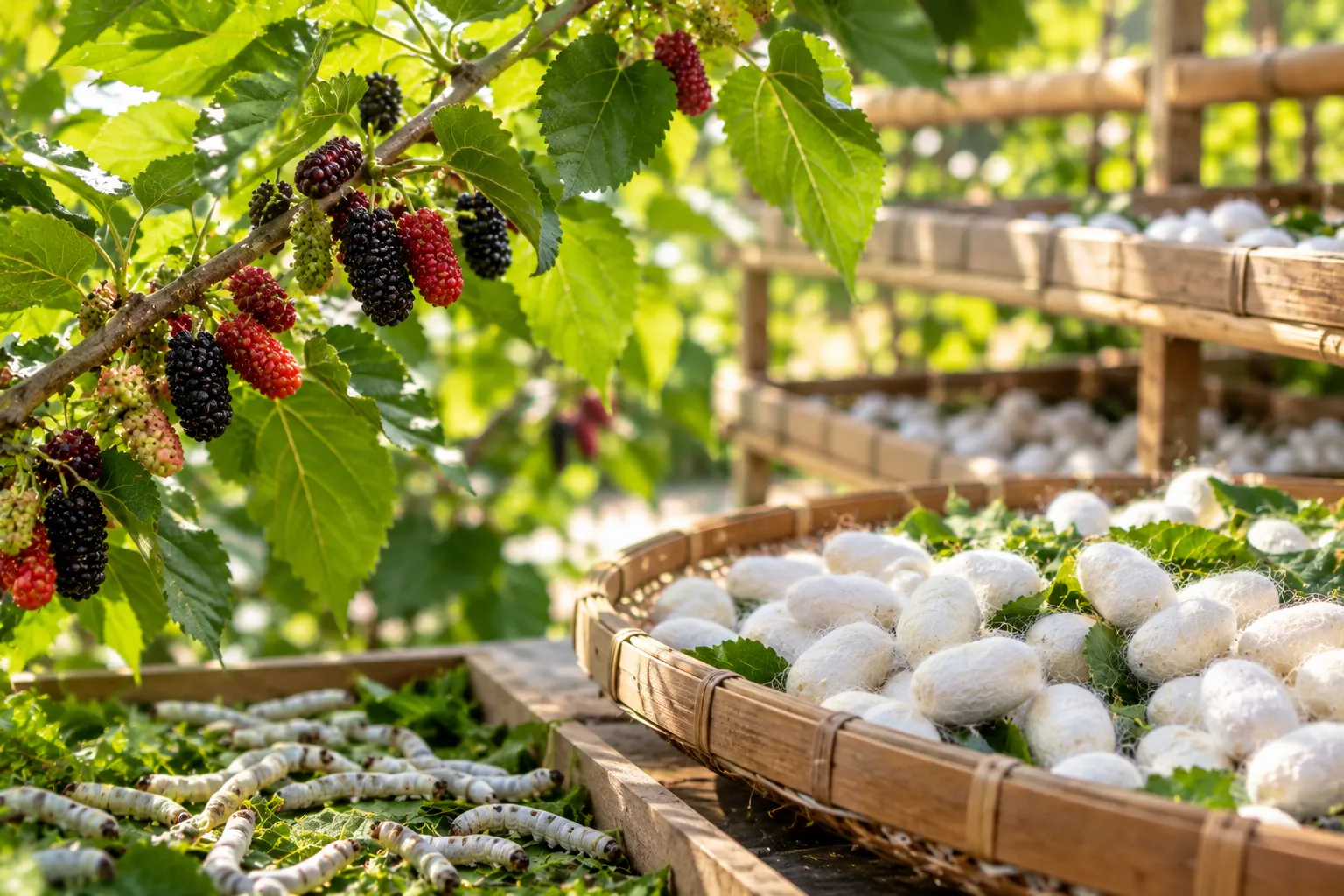
Mulberry is not a decorative tree in this forest — it is infrastructure. The Forest Department’s own species statement lists mulberry among the species grown across the plantation, alongside shisham and eucalyptus, and wildlife listings treat white mulberry (Morus alba) as one of the forest’s indicator plants. The reason is simple biology: silkworms eat mulberry leaves, almost exclusively, and Punjab’s sericulture programme was deliberately built around irrigated forest plantations where mulberry “was available in abundance to provide foliage to silkworms for feeding”, in the department’s own words.
The department’s sericulture overview traces the modern connection to 1947: sericulture was introduced in the Taxila locality of Punjab immediately after independence, arriving through Kashmir — which the department calls the gateway of sericulture — and then spread to and around the irrigated forest plantations, Changa Manga included. Mulberry also pays its way beyond silk: the department notes the fleshy twigs are cut and woven into baskets, canopies and hats sold in vegetable and fruit markets, a small cottage by-industry of its own.
The Season, the Cycle and a Packet of Eggs
Silkworm rearing runs on a rhythm that the department’s sericulture page spells out plainly. The most active season in Punjab is spring, January to April, when mulberry foliage is at its best; mulberry itself is planted in spring with a tight one-to-two-foot spacing between plants. Once a farmer’s eggs hatch, the whole production process — feeding, cocoon formation, and sale — completes within 30 to 35 days. Independent reporting from 2022 puts the practical window a little wider, around 45 days from buying eggs to selling cocoons, which is honest biology: insects do not read official timelines.
The unit of work is the packet of seed — roughly 3,000 to 4,000 silkworm eggs. A family of five in Changa Manga, profiled in 2022 reporting, could raise two packets in a season alongside regular farm work. The trays need near-constant attention in the rearing weeks: leaves picked fresh from the mulberry rows several times a day, temperature watched, disease kept out. It is exactly the kind of steady, home-based work that fits the villages strung along the forest’s edge — which is why the department keeps describing sericulture as a cottage industry rather than a plantation-scale one.
The Money Question, Answered Honestly
Silk income stories swing from inspiring to inflated, so here is what named sources actually say. In October 2025, the president of the All-Punjab Silk Farmer and Trader Association, Rana Saeed Anwar, put it at around Rs 50,000 per packet of seed reared by a family. Two years earlier, 2022 reporting from Changa Manga quoted a rearing family — Muhammad Aslam’s — at Rs 70,000 earned in a single month, with three packets in a season reaching Rs 80,000 to 90,000, and families that manage two seasons a year touching roughly Rs 150,000. That same spring, families around Aslam’s village raised about 1,500 packets between them — evidence that the trade, at least in good years, is genuinely shared rather than concentrated.
The honest caveats matter as much as the numbers. These are reported figures, not salaries: cocoon prices move, broods fail, and the 2016 record below shows how badly a bad decade can go. Treat Rs 50,000 per packet as the official-side estimate and the higher figures as best-case season outcomes, not promises.
One of Punjab’s Seven Sericulture Centres
The department maintains seven sericulture demonstration and training centres across Punjab — Faisalabad, Sara-e-Alamgir, Sargodha, Head Marala, Chichawatni, Mianchannu, Mitha Tiwana, and Changa Manga. The centre’s job is exactly what the name says: demonstrating modern rearing technique to farmers and training new ones, so the cottage industry does not run purely on inherited know-how. The department also lists Changa Manga among the silk markets where rearing families bring finished cocoons for sale — which makes the forest not just a food source for the worms but a marketplace for the trade that depends on them.
That infrastructure is why the mulberry acreage matters. Department figures reported in October 2025 put about 150 acres of mulberry inside Changa Manga — the single largest holding in a Punjab-wide total of roughly 400 acres, ahead of Chichawatni’s 60. Where the leaves are, the worms and the wallets follow.
The Collapse That Nearly Ended It
The silk story here is not a straight line. Reporting from March 2016 described an industry in real trouble: imported Japanese mulberry varieties, planted across 100 acres, producing silk of a quality — hard in texture, yellowish in colour — that found no international demand; locally produced silkworms dying at high rates; and the number of small silk factories around the forest collapsing from roughly 300 to barely 10. Around 1,000 poor families had once depended on the trade. Cheap cocoons smuggled from Afghanistan, selling at Rs 100 a kilogram against the local Rs 500, gutted the price a farmer could ask.
The same reporting was scathing about officialdom, claiming the department had failed to produce even one kilogram of cocoon in a decade while the local mulberry stock went infected and under-tended. Whatever the full truth of that decade, the pattern is clear: when the mulberry rows were neglected, the whole chain above them — worms, cocoons, factories, families — unwound with them.
The 2025 Revival Push
The reason this story is live again is arithmetic: Pakistan imports roughly Rs 112 billion of silk every year, and in October 2025 the Forest Department announced a drive to revive Punjab’s sericulture sector and claw a share of that back through local production. The department’s Deputy Director of Sericulture, Farooq Bhatti, framed the logic plainly: “Silkworms feed on mulberry leaves. That is why this cottage industry thrives in areas where mulberry tree plantations exist.” With Changa Manga holding the largest mulberry acreage in the province, the forest sits at the centre of whatever that revival manages to become.
“By promoting local production of natural silk, a considerable portion of foreign exchange can be saved,” Bhatti said — the economics of a cottage industry restated in national-account terms.
Can Visitors See Any of This?
Honest answer: not as a scheduled attraction. There is no silk-farm tour, no ticketed demonstration, no souvenir counter selling Changa Manga cocoons — sericulture here is a farming livelihood, not a show. If the subject pulls at you, the realistic options are these: visit in the spring window (January to April) when rearing is active and the mulberry rows are at their fullest; ask at the forest office or the sericulture centre whether anything can be seen that day; and remember the forest park itself is in the middle of the redevelopment, so check the current status before planning any trip. If you think in Roman Urdu, Changa Manga kb khule ga? tracks the same ground.
Why This Story Belongs on a Visitor Guide
Because it explains what the forest is. Changa Manga was planted by hand in 1866 to supply railway sleepers; it outlived that purpose to become a wildlife reserve, a picnic ground and an economy all at once. The mulberry rows and the families who farm them are part of that same living machine — a forest that has never been only scenery. If you want the wider picture, the forest guide covers the plantation’s history and wildlife, and the development project breakdown shows how the visitor side is being rebuilt around it. The silk trade is the quiet thread that ties all of it together: trees planted for one industry, sheltering another, feeding a third.
Planning the trip? Start at the Changa Manga homepage — current status, timings and tickets in one place.