Timber built this forest, silk funds some of its families — and honey is the sweetest chapter of its economy, and the best documented. Beekeepers have long kept hives in and around the 12,500-acre plantation, moving boxes between the flowering blocks as the seasons turn. What makes the story worth telling is not the romance of it but the numbers: honey is the clearest, best-sourced example of the forest paying its community in more ways than one.
The Numbers: 725 kg to 1,300 kg
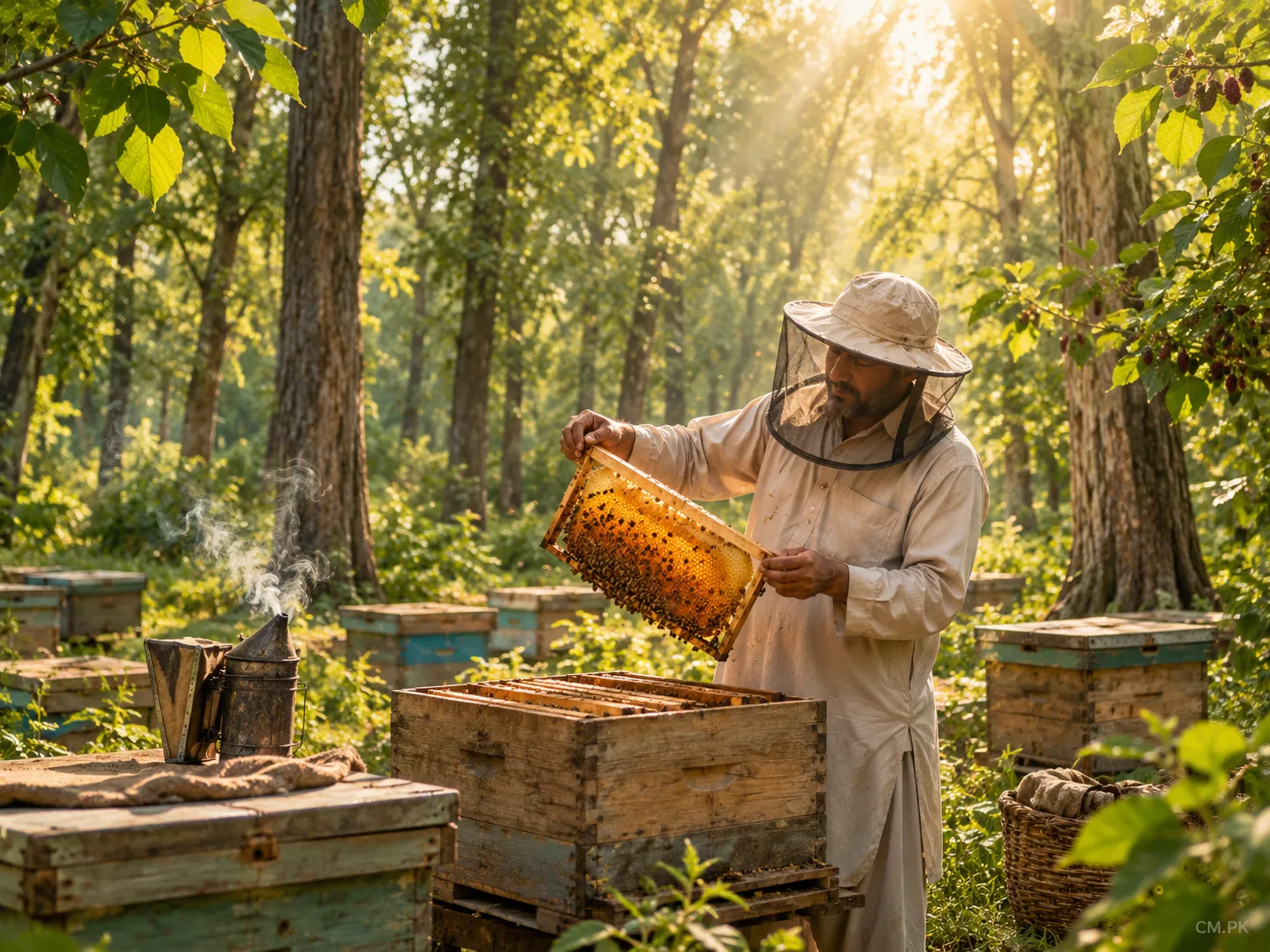
The cleanest figures come from Reuters reporting datelined Changa Manga, July 2020. “The amount of honey harvested by beekeepers in the 12,500-acre forest almost doubled from 725 kg (1,600 pounds) in the fiscal year 2018-2019 to about 1,300 kg in 2019-2020,” said forest officer Shahid Tabassum. A doubling of harvest in a single year is a striking jump for any agricultural trade — and in this case the cause was not luck but land management, as the next section explains.
The department’s own sales figures point the same direction. Honey sales recorded at the forest rose from about Rs 729,000 in FY2016-17 to Rs 1.3 million in FY2019-20 — a near-doubling over three years that matches the harvest numbers and shows the trade turning into real income rather than staying a hobby.
Why Planting Trees Made More Honey
Here is the mechanism, and it is beautifully simple: bees eat nectar, trees make nectar. During the restoration push — the same programme that replanted thousands of acres lost to illegal cutting — roughly 3.5 million new trees went into 6,000 acres of Changa Manga. More trees meant more blossoms, and more blossoms meant more forage within flight range of the hives. The beekeeping family that works the forest connected the dots in the 2020 reporting: “As more of the plantation has been created, our honey production has kept on increasing,” said Bilal Hussain, whose father runs the forest’s honey operations — a trade the family expects to hand down, “generation by generation. As long as the forest is there, honey is there.”
That quote is the whole ecological argument for reforestation compressed into one sentence. The deforestation and restoration ledger tracks the planting push in numbers; the tree species guide covers what actually grows in those blocks — shisham, mulberry, eucalyptus and the rest — which is precisely the forage calendar the bees work through.
The Honey Economy Beyond the Forest
Zoom out and Changa Manga sits inside a national trade worth watching. The same 2020 reporting, drawing on Pakistan’s Honeybee Research Institute (HBRI), recorded about 7,000 commercial beekeepers managing more than one million beehives — with capacity for double that number — and honey exports worth Rs 966 million (about $5.8 million) in FY2018-19, roughly Rs 260 million higher than the previous year. In 2026, state media was still telling the same story at national scale: the expanding forest cover — with Changa Manga’s 3.5 million trees cited as the flagship example — is “sweetening the honey industry and boosting rural livelihoods.”
For the forest itself, honey is one strand in a wider basket of economies that make it more than scenery: the mulberry rows that feed the silk (resham) trade, the timber blocks worked on rotation for a century, and the beekeeping boxes working the same ground. A forest that pays its neighbours is a forest that survives — which is, not coincidentally, exactly what the restoration programme needed.
Can Visitors Buy Changa Manga Honey?
Honest answer: not reliably right now. Historically, honey from the forest’s operations was sold at the park — the sales figures above exist because jars moved over a counter. But the park is in the middle of the redevelopment, with closure reported since early 2026 and no official reopening date as of 22 October 2026, so there is no dependable way to buy at the gate today. Check the current status page before planning any purchase trip — and when the park reopens, buy in person from the forest’s own counters rather than trusting online sellers using the forest’s name. If you think in Roman Urdu, the kb khule ga page tracks the same reopening question.
One more honest note: we do not verify any particular jar as “pure” — that is a promise no visitor guide can check from a desk. What we can verify is the institutional story: a documented harvest, named forest officers, dated figures, and a family trade that measures its good years in the growth of the forest around it.
Why This Story Belongs on a Visitor Guide
Because it reframes what the forest is for. Changa Manga was planted in 1866 to supply railway sleepers; it survived that mission to become a wildlife reserve, a picnic ground and a working landscape that feeds families in half a dozen ways. Honey is the most legible of those ways — you can taste the reforestation programme, literally, in a jar. When the park reopens and the counters start selling again, you will know exactly what you are buying: the sweetest yield of 3.5 million trees.
More on the forest: the Changa Manga guide covers status, timings, tickets and the stories behind them.