
Ask what trees grow in Changa Manga and the internet answers with one confident sentence: over 150 species, pine included. It circulates on Facebook — departmental posts included. The department’s website describes a much shorter list. We checked both against a peer-reviewed survey of the plantation on 15 October 2026. That survey is far from the only paper — Changa Manga is one of Pakistan’s most-studied forests, a story the living-laboratory science guide documents with DOIs, from a 1917 working plan to six fungi new to science.
Status note (15 Oct 2026): the forest park is widely reported as temporarily closed for the eco-tourism redevelopment, with no official reopening date announced. Planning a visit? Check the current status first: Is Changa Manga Forest Open or Closed?. The trees stand there whatever the gate is doing.
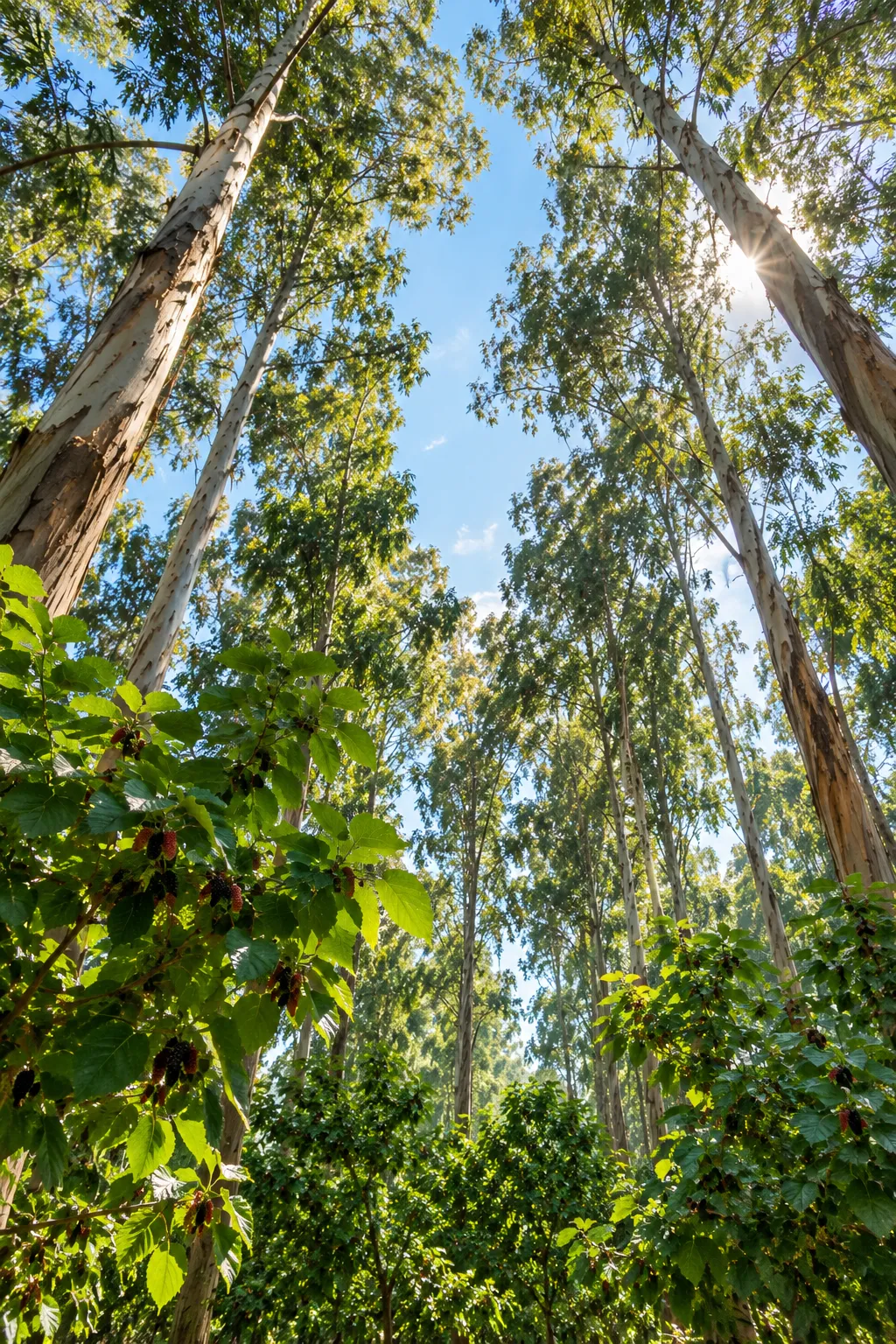
The Official List Is Nine Names Long
The department’s Changa Manga Plantation page puts it in one paragraph: “Presently Shisham and Eucalyptus are the principal species growing over a major portion of the plantation area. Other species growing are Mulberry, hybrid-poplar, semal, bakain and kiker.” Bamboo gets one line: grown “on experimental basis” — a trial, not a grove. Nine names, no species count, no pine. One of the nine, the mulberry, has a story of its own — our shahtoot aur resham guide follows the mulberry–silk thread through the plantation’s economy.
The local names decode where records allow. Shisham is Dalbergia sissoo and kikar is Acacia nilotica, both native to the subcontinent and the plantation’s founding pair; mulberry is Morus alba; semal is Bombax ceiba. The identifications come from Wikipedia’s flora summary, which also notes “several species of Eucalyptus and Populus” in the stock. Bakain keeps only its local name in the records we checked. The same page adds one working number: about 500 acres are afforestated or regenerated every year — the mix is managed, not frozen.
Why a Tree Farm, and Why These Trees
Changa Manga was never wild woodland, and the species list proves it. In 1864, by Wikipedia’s account, the North-Western Railway found itself “starved of resources”; Dr John Lindsay Stewart, the first Conservator of Forests of Punjab, recommended growing fuel on purpose — a plantation block for each railway district. The forester Berthold Ribbentrop planned the crop: mulberry and sheesham. Planting began in 1866 on 8,400 acres; the first real harvest came in 1888, from the second rotation. The founding math: 4,850 cubic feet of mature crop per acre on a fifteen-year rotation, to feed five trains running daily, each burning 80 pounds of fuel a trip. An FAO study note puts the purpose plainly: Punjab’s irrigated plantations were established “mainly for production of fuel wood for steam engines”. Our history article tells the founding story.
The Mulberry Understorey
The mulberry was never just a crop tree. The same FAO note records that mulberry is raised as an understorey crop beneath sissoo — “the combination of both the species has become a great success, especially in Changa Manga Plantation”. The department’s services list echoes that system — timber, firewood, planting stock, honey, mulberry twigs, basket work, silk thread. The silk has history: in the 1910s a Salvation Army experiment raised silkworms there on mulberry leaves from felled forest trees, seventy hundredweights a day, by Wikipedia’s account. That services list is the industrial past, printed as a menu — and the honey line on it is the one that grew the fastest: the forest’s documented harvest nearly doubled in a single year, a story with its own page at honey from Changa Manga.
What the Peer-Reviewed Survey Found
In December 2024, BMC Plant Biology published a survey of the plantation — 127 stands, counted. Its tally: 168 plant species across 38 families — canopy trees, grasses, herbs alike — in six distinct plant communities. Dalbergia sissoo dominates its own community; Eucalyptus camaldulensis leads another, in stands the authors read as eucalyptus monoculture, with reduced understorey diversity beneath. Lantana camara, an invasive, stands co-dominant in the shisham community — a disturbance marker, in the authors’ reading.
And the “150 species, including pine”? From Facebook, departmental posts included — and nowhere else we could fetch. The website names nine species without pine; the survey’s 168 are plant species, not tree species, and record no pine. We are not declaring pine absent. We are saying no source checked on 15 October 2026 confirms it; until an official list does, the nine-name page is the record.
Before the Forest, a Thorn Scrub
The department’s page records what stood there first: a dry-zone rakh — natural tropical thorn forest of scattered jand (Prosopis cineraria), wan (Salvadora oleoides), karir (Capparis aphylla) and rehru (Acacia leucophloea). Little of that scrub survives as canopy; the forest is a farm crop in its second century. Its main crop carries a live risk: sissoo die-back, the crown-thinning disease the FAO note documents across central Punjab. The replanting under way after years of illegal cutting — 1,500 acres restored, 150,000 poplars among the stock, as our deforestation explainer details — leans on fast growers. The wildlife this man-made canopy shelters, from jackals to the vultures of the WWF centre, exists because someone keeps choosing the species.
Questions People Actually Ask
What is the most common tree in Changa Manga?
Shisham and eucalyptus — the two species the department calls principal; the 2024 survey found Dalbergia sissoo the dominant species of its community.
Are there pine trees in Changa Manga?
No source we could verify — the department’s website, Wikipedia, the FAO note or the 2024 survey — lists pine. The department’s own social media says otherwise; we flag that as unverified rather than repeat it as fact.
Is Changa Manga a natural forest?
No. It was planted from 1866 as a railway fuel and timber plantation, and the official species list still reads like a planting plan.
Where This Leaves You
Every tree in Changa Manga was a choice, and the choices are on record. When the gates reopen, the forest guide gives the plantation at a glance, the birdwatching guide explains why the canopy matters to birds, and things to do lists the official ways through it. Any of them reads like a planting plan 150 years old and still being revised.
Species claims above trace to the department’s plantation page, Wikipedia’s flora section, an FAO study note and a December 2024 BMC Plant Biology survey, all checked 15 October 2026. The pine claim is flagged unverified; we publish nothing we cannot trace.
Before you drive: check the Changa Manga forest park homepage for the latest status and ticket info.