
Every great forest has an origin story. Changa Manga’s happens to involve outlaws, steam engines, and one of the largest acts of collective tree-planting in human history.
The Outlaws in the Name
The forest takes its name from Changa and Manga, two brother dacoits who terrorised the countryside of what is now Kasur District in the nineteenth century. Legend has it that the brothers used the region’s natural scrub as a hideout, striking at travellers and disappearing into the thorn jungle that the British administration struggled to control.
The story ends the way such stories usually ended in colonial police reports: the brothers were caught and hanged. But their names refused to die. When the government later began planting a forest on that same ground, the locals kept calling it by the outlaws’ names — and the name simply became official. Today it is one of the very few forests on Earth named after bandits, and grandparents around Chunian and Pattoki still invoke Changa Manga to keep misbehaving children in line.
A Forest Built for Steam Engines
Here is the part that surprises most first-time visitors: Changa Manga was never a wild forest at all. It was planted in 1866 by British foresters with a single industrial purpose — to grow timber for the expanding railway network of the subcontinent.
Steam railways consumed wood on an industrial scale: sleepers, carriages, bridges, fuel. Rather than strip-mine natural forests, the administration chose to farm trees. Vast rectangular blocks of hardwood — most famously shisham (Dalbergia sissoo) — were planted, tended and harvested on rotation, year after year, for over a century.
From Tree Farm to Treasure
Something unexpected happened along the way. The plantation grew into a genuine ecosystem: 12,510 acres of irrigated forest, according to the Punjab Forest, Wildlife & Fisheries Department, sheltering jackals, wild boars, mongooses, partridges, peacocks and one of the most important vulture conservation programmes in South Asia.
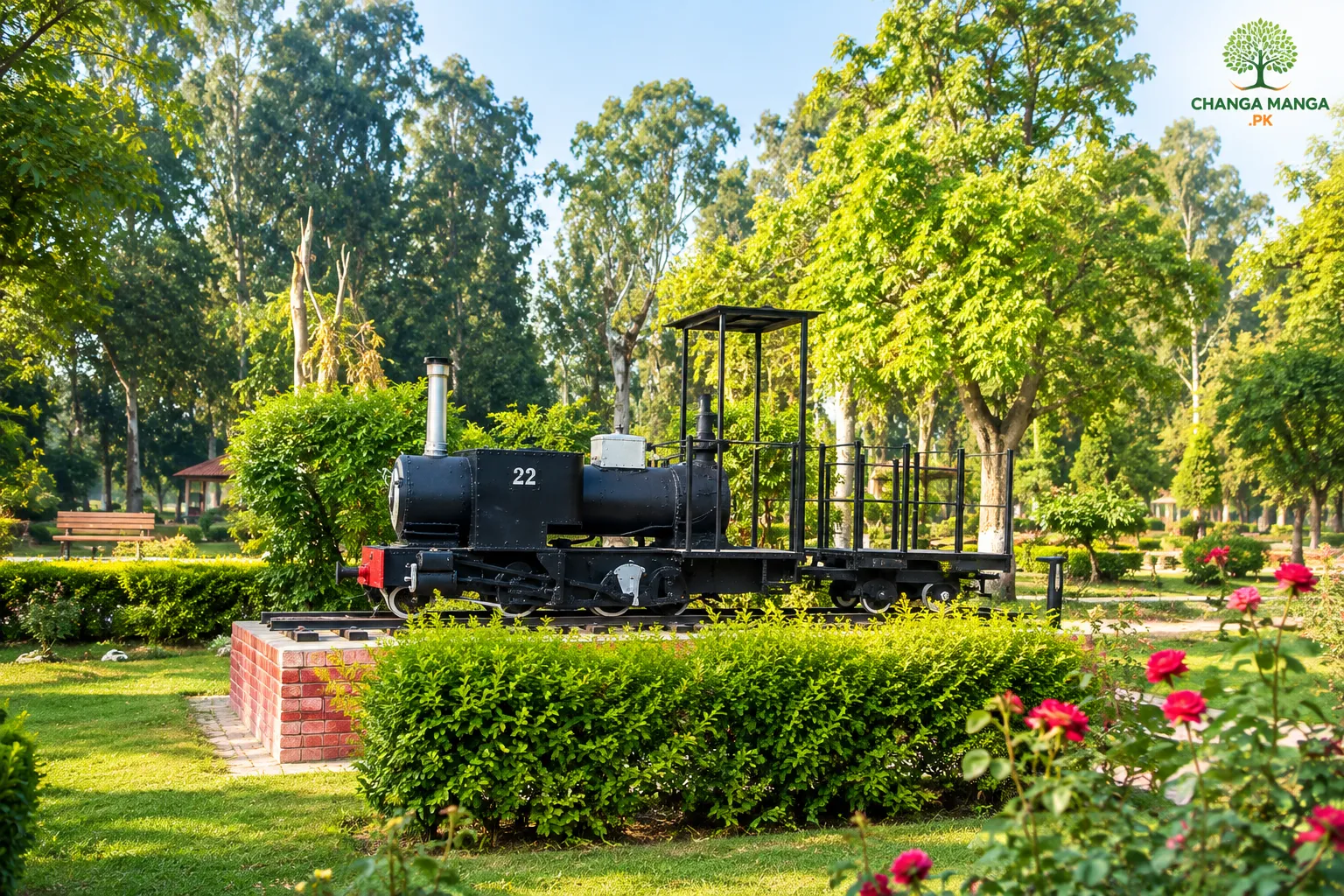
The forest also became a cultural institution. For generations of families in Lahore, “Changa Manga” has been shorthand for the school-trip day out — the little train, the swaying bridge, the picnic under the shisham. The little train carries enough history to fill its own guide.
Is It Really the Largest Man-Made Forest?
You will see the superlative everywhere — “the largest man-made forest in the world” — so it deserves an honest answer. Wikipedia’s entry still opens with the claim that Changa Manga was once the largest hand-planted forest in the world, before noting that illegal deforestation has shrunk it at a massive scale in recent decades. A 2012 assessment put the loss at roughly 75% of the original woodland, and a UN-affiliated project database records the Punjab government’s response: boundary fencing, a 39 km double-row planting belt and about 1,500 acres replanted, with roughly 4,000 acres of blank ground still awaiting regeneration. So the precise wording matters: Changa Manga is Pakistan’s largest hand-planted forest and one of the largest anywhere — but the “world’s largest” superlative is now history, not present tense. The full rise-and-shrink story is in our deforestation explainer.
Why the Story Still Matters
A forest that was planted as an industrial raw material is now protected as a recreation and conservation asset. That is a quiet lesson about patience: nobody who held the first shisham sapling in 1866 lived to see the full canopy. The forest is, quite literally, a gift that nineteenth-century foresters handed to twenty-first-century Pakistan — and a gift that has already been nearly lost once, as our deforestation explainer documents.
Next time you walk its straight, sun-dappled avenues, remember: every tree you pass was put there on purpose, by hand, more than 150 years ago. Not many places let you stand inside someone else’s long-term thinking quite like that. If that walk is on your list, check the current status first — day-to-day access is exactly what the redevelopment is changing. For what is actually being built behind the gates, the safari park tracker keeps the running record.
Questions People Actually Ask
Why is it called Changa Manga?
After two brother dacoits, Changa and Manga, who reportedly used the area’s scrub as a hideout in the nineteenth century and were eventually caught and hanged. When the government planted a forest on that same ground, locals kept using the outlaws’ names — and the name simply became official.
Who planted the Changa Manga forest, and why?
British foresters planted it in 1866 to supply timber — sleepers and fuel — to the subcontinent’s expanding railway network. Shisham (Dalbergia sissoo) was the most famous species, grown in vast rectangular blocks and harvested on rotation for over a century.
Is Changa Manga the largest man-made forest in the world?
It was once described as the largest hand-planted forest in the world, but a 2012 assessment put illegal deforestation at roughly 75% of the original woodland, and restoration is ongoing — about 1,500 acres replanted with roughly 4,000 acres still pending. The honest claim today: Pakistan’s largest hand-planted forest, and one of the largest anywhere. The full rise-and-shrink story is in our deforestation explainer.
How old is Changa Manga forest?
Planted in 1866, which makes it 160 years old in 2026 — a forest deliberately grown, tree by tree, across a century and a half.
Changa Manga ka naam kyun rakha gaya?
Do bhai dacoits — Changa aur Manga — ke naam par, jo 19vi sadi mein isi ilaqay ke thorn jungle mein chhup kar hamla karte thay aur aakhir pakre gaye. Jab sarkar ne wahin jungle lagaya to logon ne outlaw ke naam hi bolna jaari rakha, aur wohi naam official ban gaya.
Kya Changa Manga duniya ka sab se bara man-made forest hai?
Kabhi aisa kaha jata tha. 2012 ki assessment ne taqreeban 75% illegal katai dikhaayi; taqreeban 1,500 acres dobara lagaye ja chuke hain aur 4,000 acres pending hain. Sach yeh hai: yeh Pakistan ka sab se bara hand-planted forest hai aur duniya ke baray hand-planted forests mein shumar hota hai — magar ‘duniya ka sab se bara’ ab tareekh hai, haal nahi.
Key facts in this article were checked against the Punjab Forest, Wildlife & Fisheries Department, Wikipedia, UN-affiliated project databases and historical railway archives on 18 October 2026. See our forest guide for the full source register.
New here? The Changa Manga visitor guide opens with the current status, timings and ticket basics.