
Changa Manga is a forest that humans made — and, rather wonderfully, wildlife adopted anyway. Beneath the tidy plantation avenues lives a quieter population: jackals on the night shift, mongoose families working the verges, and a conservation story centred on one of the subcontinent’s most endangered birds. Here is what is actually recorded in the forest, and how to be the kind of visitor who notices it.
Status note (29 Oct 2026): the forest park has been reported temporarily closed for redevelopment through 2026 — see the current status. The wildlife, of course, has not paused; this guide will be waiting for you when access resumes.
The Mammals: Mostly Secretive, Occasionally Seen
Ecological assessments of the Kasur district forests record golden jackals, wild boar and mongooses among Changa Manga’s resident mammals, alongside porcupines in suitable habitat. None of these animals performs for crowds. Jackals are the forest’s most famous voices — a pre-dawn chorus from deep in the plantation is a genuinely wild sound for a wood only 74 km from Lahore — while daytime sightings usually amount to a flash of movement between tree rows.
Wild boar leave the most visible traces: churned earth along the plantation edges and, occasionally, a family party crossing a quiet track at dusk. Mongooses are the daylight delight — quick, inquisitive, and often seen trotting the grass margins with tails high. The forest’s history also includes its cattle era, when illegal grazing herds damaged regeneration; departmental accounts describe hundreds of animals being moved out to let new plantation survive. All of this lives under protection, not hunting licences — the shikar rules fact check separates what the law actually prohibits inside the forest from the viral claims that circulate every season.
The Birds: A Hand-Planted IBA
Birdlife is where Changa Manga truly earns its reputation among naturalists. The plantation’s variety of ages, its lakes, and its position on Punjab’s plains give birders a long list: partridges, doves, woodpeckers, barbets, drongos, minivets, owls, kingfishers at Lunar Lake, and wintertime visitors that arrive with the cold. Peafowl are widely reported and beloved — though, as with everything on this site, we record what sources document rather than promising you a sighting.
The best birding windows follow the forest’s own clock: the first two hours after sunrise, and the hour before dusk. Winter mornings are the most generous of all, when the light is long, the air is clear and resident species are joined by migrants. Our season-by-season guide covers the timing in detail.
The Vulture Centre: The Forest’s Biggest Conservation Story
Tucked inside Changa Manga runs one of Pakistan’s most important conservation facilities: the WWF-Pakistan Vulture Restoration and Captive Breeding Facility — the country’s only ex-situ vulture conservation initiative. Its focus is the Asian white-backed vulture, a species pushed to the edge across South Asia primarily by the veterinary drug diclofenac, which poisons vultures that feed on treated livestock carcasses.
The centre’s work is patient: keeping a genetically healthy captive population alive, breeding chicks, and preparing for restoration to the wild. There are encouraging signs — wild vultures have been recorded visiting the site from outside. For visitors, the facility is a reminder that the forest’s value reaches far past picnic lawns: it functions as a refuge in a landscape where safe habitat is rare. The full story — the diclofenac collapse, the 2004 founding, every published chick count and why no birds have been released yet — has its own page: the vulture centre at Changa Manga.
The Managed Side: The Wildlife Park
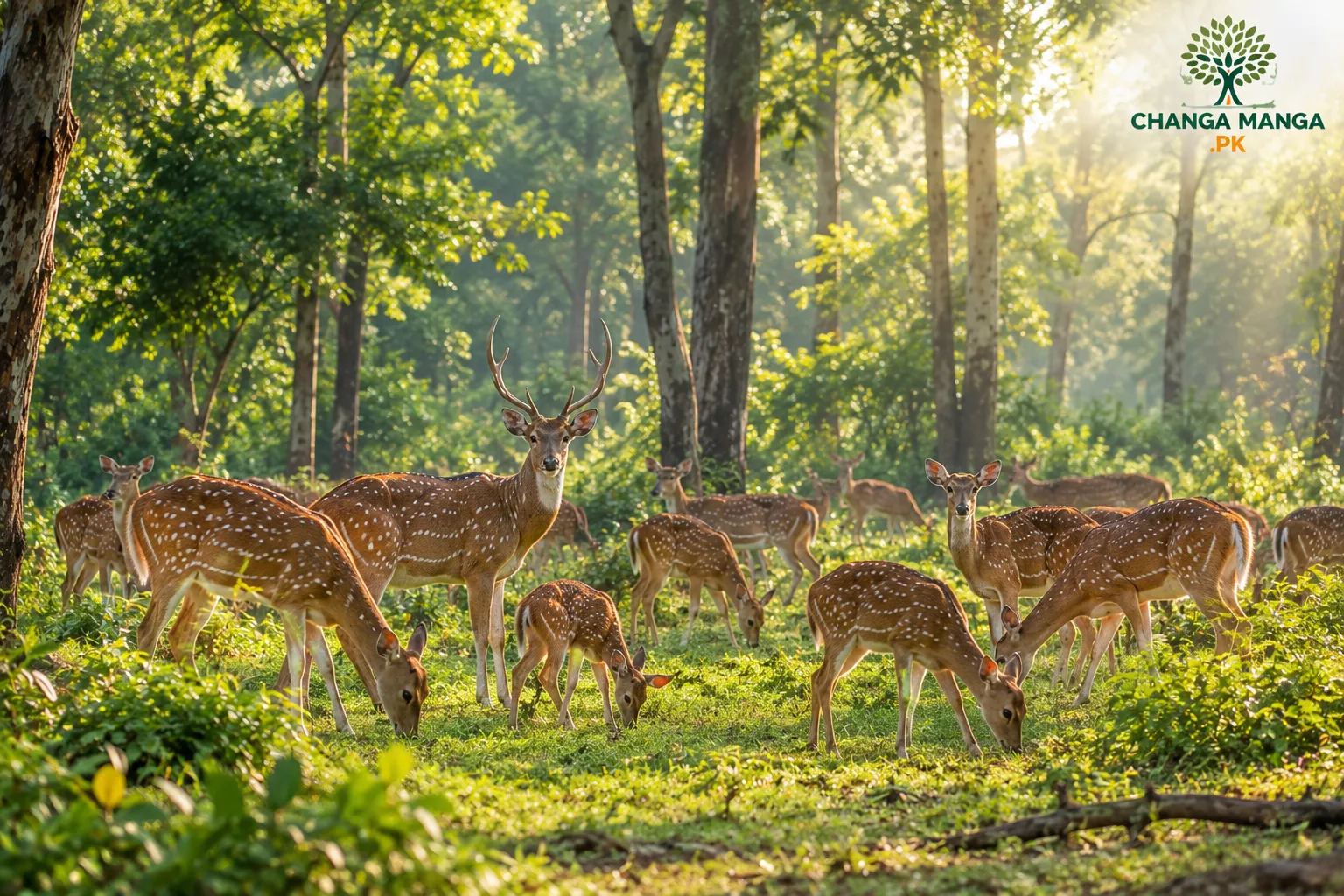
Changa Manga also has a managed wildlife park and mini zoo within the recreation area — historically housing deer species including blackbuck and chital, alongside other display animals, and long a favourite of family picnics. The zoo area has known real loss: in March 2023 a forest fire burned through the zoo area and killed hog deer, reported by Dawn (20 March 2023) and The Express Tribune (21 March 2023). Two more honest notes: the zoo’s population and presentation have changed over the years, and like everything inside the park, its current operations are affected by the redevelopment. We deliberately do not publish an animal list we cannot verify as current — treat any specific zoo claim online with care until the reopening clarifies what operates.
Watching Wildlife Responsibly
- Keep voices low and let the forest come to you; jackals and birds alike retreat from noise long before you see them.
- Stay on paths and lawns. The undergrowth is habitat, not shortcut.
- Never feed animals — it changes behaviour and harms health, and it applies as much to boar as to macaques.
- Dawn and dusk beats noon, in every season, for every species.
- Binoculars beat cameras at Changa Manga; distances inside the plantation are long and the light is dappled.
The forest was planted for railway sleepers and became a refuge. That double identity — industrial origin, wild heart — is what makes wildlife-watching here different from a city park and safer than a true wilderness. When the gates reopen, bring binoculars and patience. The forest will supply the rest.
Questions People Actually Ask
What animals live in Changa Manga forest?
Ecological assessments of the Kasur district forests record golden jackals, wild boar and mongooses among the resident mammals, alongside porcupines, with partridges and many more bird species across the plantation. Peafowl are widely reported, and the WWF-Pakistan vulture breeding facility works inside the forest. Our birdwatching guide goes deeper.
Are there lions or tigers in Changa Manga?
No. No free-ranging big cats are recorded in the forest — its wild mammals are jackals, wild boar and mongooses. The managed wildlife park and mini zoo historically held deer species and other display animals, but its current operations are affected by the redevelopment. For the lion and wolf videos circulating on social media specifically, our lions & wolves fact check goes through them one by one.
What is the vulture centre at Changa Manga?
The WWF-Pakistan Vulture Restoration and Captive Breeding Facility — Pakistan’s only ex-situ vulture conservation initiative. It breeds the critically endangered Asian white-backed vulture, whose decline was driven mainly by the veterinary drug diclofenac. Wild vultures have even been recorded visiting the site.
When is the best time for birdwatching at Changa Manga?
The first two hours after sunrise and the hour before dusk. Winter mornings are the most generous of all, when residents are joined by migrants and the light stays clear. Bring binoculars — distances inside the plantation are long. The season guide covers the timing.
Changa Manga mein kaun se janwar paye jate hain?
Ecological assessments ke mutabiq golden jackal (siyar), jangli soor (wild boar), nevla (mongoose) aur porcupine record hain; teetar aur baray panchhi bhi. Mor (peafowl) aam report hote hain, aur WWF ka vulture breeding centre bhi isi jungle mein hai.
Kya Changa Manga mein sher hote hain?
Nahi. Jungle mein koi azad sher ya tiger record nahi — yahan ke wild janwar siyar, jangli soor aur nevla hain. Mini zoo mein tareekhi tor par deer aur deegar janwar thay, magar uski maujooda haalat redevelopment se mutasir hai.
Species records reflect published ecological references for the forest and conservation reporting by WWF-Pakistan; see our forest guide for the full source list.
More on the forest: the Changa Manga guide covers status, timings, tickets and the stories behind them.