
Type “Changa Manga hunting” into a search bar and the results read like a tangle. Outfitter pages advertise wild-boar drives in “the forest plantations of Changa Manga”. Facebook serves up shikar clips wearing the forest’s name like a caption badge. And the park’s own official channels, in the same feed, celebrate rescued hog deer being released back into the sanctuary. Which version is true? All three — they just happen in different places, under different rules. This page separates them with the actual legal record, because the difference between a farm field and a protected plantation is the whole story.
The Short Answer
- Hunting inside Changa Manga? Prohibited. The forest is a protected plantation — a forest park with a wildlife sanctuary component — and its animals are shielded by provincial wildlife law.
- Wild boar hunting on farm land? A separate, legal reality. Boar are classified as crop pests in Punjab, and licensed culling happens on private fields — outside the forest, not inside it.
- Viral shikar clips labelled Changa Manga? They fail the two fastest checks: the habitat and the species list.
- Penalties are real: imprisonment and fines under the Punjab Wildlife Act, a framework tightened by amendments in 2023 and 2025.
- Saw something? Report it to the forest staff or the wildlife department — don’t confront anyone yourself.
What Changa Manga Is, in Law
Start with what the forest actually is. Changa Manga was planted in 1866 as a timber plantation and is managed today by the Punjab Forest Department’s Kasur Forest Division. Within the wider estate sits a wildlife sanctuary component: published research on the forest’s hog deer stock describes the animals as held “at Changa Manga Wildlife Sanctuary”, and the wildlife department’s own posts record rescued deer being released into it. This is not a paper distinction — it is the category that decides what may and may not happen to the animals living there.
The legal shield is the Punjab Wildlife (Protection, Preservation, Conservation and Management) Act, 1974 — the province’s umbrella wildlife law, amended in 2023 and again in 2025. The Act restricts hunting (section 9), forbids hunting and shooting in game reserves except under a special permit, and places wildlife parks and sanctuaries under the strictest provisions of all. Its penalty sections run to imprisonment and fines — the consolidated text sets minimum fines for several wildlife offences at twenty thousand rupees, with the amendments strengthening the framework further. In plain language: inside this forest, wildlife is not a resource to harvest. It is the thing being managed.
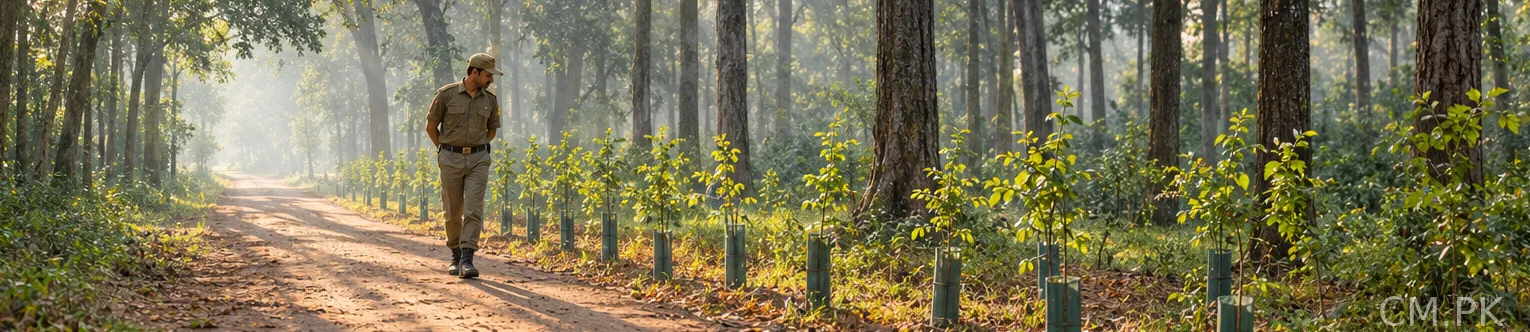
Why “Changa Manga” Shows Up on Hunting Pages
The confusion is not an accident; it is built on a true fact. The wild boar really is abundant here — the plantation belt is one of the species’ best-known strongholds in central Punjab, and one long-running outfitter website has listed the “forest plantations of Changa Manga” among its boar habitats for years. The habitat claim is accurate. The destination is not: commercial boar drives run on private and farm land elsewhere in the province, where landowners welcome hunters whose guns cost them nothing in permits. Advertising that experience “at Changa Manga” borrows the forest’s fame while describing activity the forest itself forbids. The same borrowed fame now labels recompiled shikar clips on social media — which is where the fact-checking gets useful.
The Boar Complication: Pest on the Field, Protected in the Plantation
Here is the kernel of truth that muddies every comment thread: wild boar hunting is not banned everywhere in Punjab. The species is treated as an agricultural pest — peer-reviewed surveys document heavy losses to maize, wheat and vegetables — and farmers can obtain crop-protection licences to cull boar on their own land, with licensing fees reported “in the thousands” of rupees. Hunting within that licensed, private-land framework is a real, legal activity.
But the distinction is exactly the point. A crop-protection licence authorises a farmer on his own fields; it does not authorise anyone to walk a weapon into a protected plantation. Inside Changa Manga the boar is not a pest to be shot — it is the most visible wild mammal of a managed ecosystem, the one our lion, wolf and boar fact-check documents in detail. Same animal, two legal worlds, and the boundary between them is the forest boundary.
The Videos, and the Two-Check Rule
The viral shikar clips collapse fastest under the same two checks we use for fake lion videos. Check the habitat: clips showing savanna grass, rocky gorges or pine ridges describe landscapes that do not exist inside this flat, irrigated plantation. Check the species: anything not on the forest’s recorded cast — no big cats, no wolves — is footage from somewhere else. And hold every clip to the geotag standard: no dated, checkable location means no claim. A real hunting video from Changa Manga would have to be a video of an arrest, and those, unsurprisingly, are not what the pages post.
If You See Something
The practical part. If you witness hunting, trapping or anyone carrying a weapon inside the forest: do not confront. Note the time and the location as precisely as you can, photograph from a safe distance if it is safe, and report to the forest staff on duty or the Punjab wildlife department. Context matters here: this forest’s wildlife management is rescue-first, not trophy-first. Hog deer have been pulled from the canal that runs through the jungle and released into the sanctuary; the deaths of two hog deer in the March 2023 fire were reported as news precisely because these animals are protected and their losses count. The reporting public is part of that system — a forest of twelve thousand acres cannot be watched by staff alone.
The Better Trophy
Hunting framed the old way takes one animal out of the forest once. A camera does the opposite: a jackal chorus filmed at dawn, a boar family crossing a quiet track, a peacock displaying on the path — those “trophies” travel, they multiply, and they leave the forest exactly as they found it. The birdwatching guide and the best-time-to-visit guide cover when and how the forest gives up its sightings honestly. One planning note before you go: the park has been reported temporarily closed for redevelopment, so check the current status page first. The forest’s real record — the jackals, the boar, the vultures, the sixty years of documented science — has never needed a borrowed trophy. Neither do you.
New here? The Changa Manga visitor guide opens with the current status, timings and ticket basics.