
Of all the conservation stories hiding inside Changa Manga, this is the biggest: tucked into a secluded corner of the forest operates Pakistan’s only vulture captive-breeding facility — the last-resort ark for one of South Asia’s fastest ecological collapses. Most visitors never hear of it. Fewer still understand what the birds inside represent: a continent-scale disaster, a detective story that changed veterinary law, and a breeding programme whose every chick is counted like treasure.
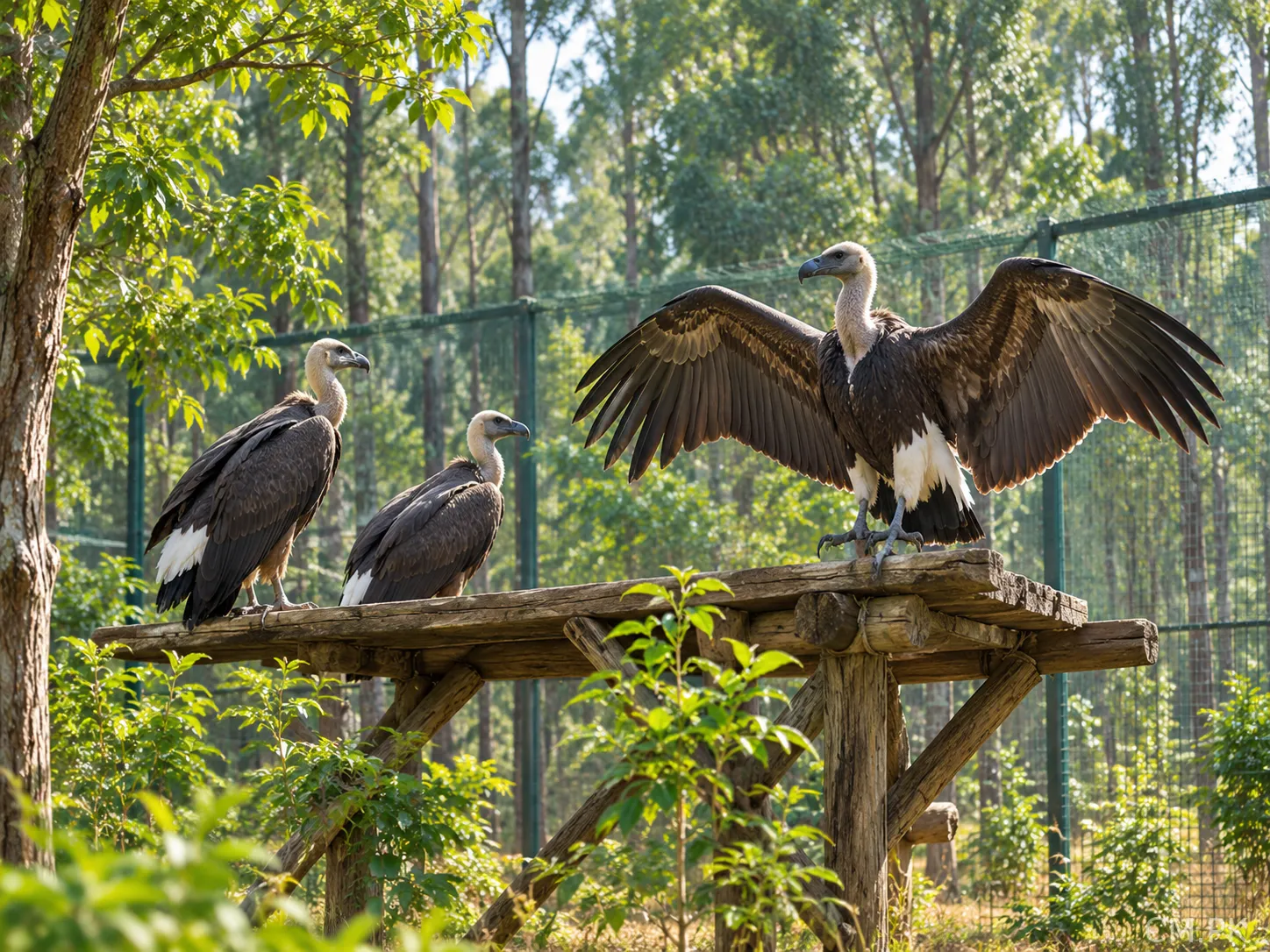
The Collapse That Made the Centre Necessary
Through the 1990s and early 2000s, vultures vanished across South Asia at a speed scientists had rarely witnessed — Asian white-backed vulture populations fell by more than 97 percent in surveyed regions. The killer turned out to be something no one had thought to suspect: diclofenac, a cheap veterinary painkiller given to cattle. It is harmless to the cows; when vultures scavenged the carcasses of treated animals, it destroyed their kidneys. The landmark proof came in a 2004 Nature study — worked, notably, with birds from colonies in Kasur district, the same district as Changa Manga. Pakistan was not just a victim of the collapse; it was where the evidence was nailed down.
The implications reached beyond birds. Vultures were South Asia’s sanitation department, stripping carcasses that otherwise rot, feed feral dogs and risk disease. Their crash was an ecological emergency with public-health consequences — and it is why a breeding centre, not just a ban, became necessary.
How the Centre Began
The response took shape in 2004, when the Pakistan Vulture Recovery Project launched as a partnership between WWF-Pakistan and the UK’s Hawk Conservancy Trust — an organisation that had worked with the species since 1997 — alongside the Punjab government. Three years later the purpose-built centre at Changa Manga was officially opened (2007), its construction funded by the Environment Agency in Abu Dhabi. The division of labour has held ever since: WWF-Pakistan runs the operation, the Trust provides the technical advisor, staff training and running costs, and the Punjab wildlife department supports field surveys tracking which painkillers are in use in the countryside. The forest’s research story runs wider than vultures — the science made in Changa Manga collects the rest.
The choice of Changa Manga was never published with an official rationale — we say so honestly rather than invent one. But the geography speaks: the district’s vulture colonies were the very ones studied as the collapse unfolded, and a quiet, protected government forest with controlled access is a natural ark.
The Breeding Record, Season by Season
Breeding white-backed vultures in captivity is slow, patient work — and the published record shows it. The first breeding season began in 2015/16 with 15 adult birds. The Hawk Conservancy Trust’s own table records the fledglings season by season: two in 2015-16, two in 2016-17, two in 2017-18, one in 2018-19, three in 2019-20, two in 2020-21, three in 2021-22 — fifteen chicks in seven seasons, each one a small victory against a 97 percent decline.
The population line tells the longer story: 15 birds (2016, when the first captive breeding success was reported) → about 20 (2017) → 25 by 2020, which the Trust called its best breeding year yet → 30 by mid-2022 → 33 birds by December 2025, when two more chicks fledged. One gap: no season count for 2022-23 was ever published, so the table has a hole — we record counts as published rather than smoothing them over. (A naming note: the Trust’s own pages alternate between “Vulture Restoration Project” and “Vulture Recovery Project”; both refer to the same programme.)
Why No Vultures Have Been Released
Here is the part that surprises visitors: not one of these vultures has been returned to the wild — and that is deliberate. The Trust’s stated position is that release is “not possible until the threats are removed”, and the threats are still live: the Trust’s February 2026 update records diclofenac still being sold, at up to 25 percent of NSAID sales in some locations, despite the bans. In December 2025 new funding was announced to push restrictions on the other cattle painkillers — aceclofenac, ketoprofen, flunixin — that carry the same kidney risk. Releasing captive-bred birds into a landscape still laced with diclofenac would spend fifteen years of patience on a fatal gamble. Punjab wildlife officials have themselves described the release question as a dilemma in print.
The centre’s work is not only breeding. In April 2026 it even played host to an unusual foreign guest: a GPS-tagged cinereous vulture from India, rehabilitated at Changa Manga after cross-border coordination between the two countries’ WWF offices — a reminder that vulture conservation ignores borders even when everything else does not.
Visiting the Centre
Set expectations honestly: this is not a zoo exhibit. The facility sits in a secluded area of the forest, and its recorded visitors are educational — school groups, University of Lahore students and government officials, per the Trust’s 2021/22 update. There is no ticket counter and no published walk-in arrangement. If the story moves you, the realistic route is to ask at the forest office whether any visit arrangement is possible — historically it has been groups, not individuals — and to check the current park status first, since the park is in redevelopment. The birdwatching guide covers the wild birds of the forest, and the wildlife overview sets the vulture centre in context of everything else that lives here. If you think in Roman Urdu, the visit question is answered in the FAQ above.
Why This Story Belongs on a Visitor Guide
Because it is the forest’s finest credential. Changa Manga is a planted forest — its trees were put there for railway sleepers — and yet within that man-made landscape operates a facility of national and international consequence, rescuing a species from a man-made catastrophe. Planted forest, man-made problem, human-led rescue: the vulture centre is Changa Manga’s whole story in miniature. The birds you cannot see on a normal visit may be the most important thing in the woods.
More on the forest: the Changa Manga guide covers status, timings, tickets and the stories behind them.